
15th century (source section) · Source account
Special Account Of William White, Touching His Doctrine, Suffering And Death.
Original historical wording. Century of containing source section; exact event date not assigned Earlier accounts express the book’s perspective on Christian continuity.
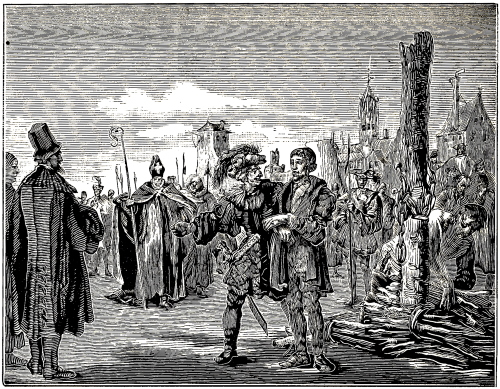
WILLIAM WHITE BURNED AT NORWICH, ENGLAND.
In the fifteenth book of the Chronijck van den Ondergang, page 788, are found the following words: “William Wicht, or William White, a learned, upright, honest, and eloquent man, a priest in England, forsook his ministry, and published the Gospel, by writing, preaching, and teaching, saying: ‘that forgiveness of sins must be obtained from God Almighty alone; that the unmarried life of the Pope and his clergy was the very satanic state, and a severe captivity of antichrist; and that the hooded, striped and shaven clergy were the mercenaries and servants of Lucifer.’ ”
But upon being apprehended, he renounced his doctrine, A. D. ——. Subsequently, however, he became re-established, and pious, and stronger, in the doctrine, and very boldly suffered burning for his confession, at Norwich, in England, A. D. 1428 334Compare this with Hist. Andr. Hondorf, fol. 35. Vincent. Cal., fol. 134. Georg. Pac. cap. 11.
Note.—Three years previous to the death of this martyr, A. D. 1425, a miserable persecution was raised by the Romanists against some orthodox Christians; concerning which the following account is found, for the year 1425: “About this time, Peter Torea was executed at Speyer, in Germany, and many others in the Roman countries; because they confessed the truth or opposed the Roman superstitions.” Georg. Pac., cap. 11, compared with P. J. Twisck, Chron., page 788.
Original heading and source location
SPECIAL ACCOUNT OF WILLIAM WHITE, TOUCHING HIS DOCTRINE, SUFFERING AND DEATH.
First Part. · AN ACCOUNT OF THOSE WHO SUFFERED IN THE FIFTEENTH CENTURY.
Read this location in the complete editionOriginal page markers: 334